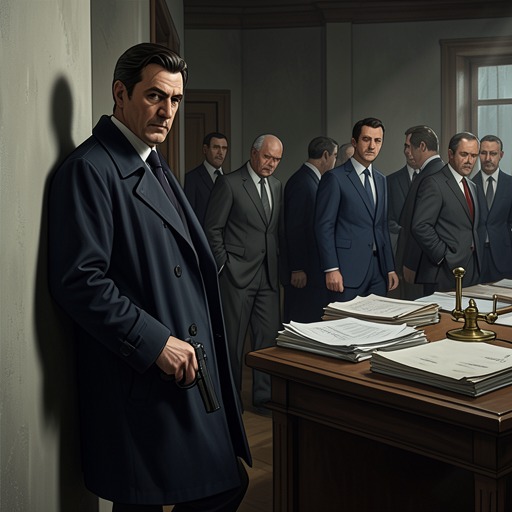
Dave Ferrie
I Heard You Paint HousesDave Ferrie is remembered here less through a full biography than through two tightly described encounters: as Carlos Marcello’s pilot, he directs a truckload of military supplies bound for Florida and, later, receives a bag of rifles at the same transfer point. In Frank Sheeran’s account, Ferrie is a practical link between organized-crime contacts and anti-Castro activity, while the limits of what Sheeran knew leave the larger operation only partly visible.
Identity and First Meeting
Sheeran first met Ferrie at Joe Sonken’s Gold Coast Lounge in Hollywood, Florida, during meetings attended by people from around the country. Ferrie was introduced as Carlos Marcello’s pilot. Sheeran recalled that Ferrie still had his hair at the time; he also relayed later reports that Ferrie was gay, while noting that Ferrie had not made an advance toward him. Sheeran’s description is anecdotal, not a broader account of Ferrie’s private life.
Ferrie’s political associations were more consequential to the story. Sheeran says Ferrie hated Fidel Castro and was close to anti-Castro Cubans in Florida. That allegiance becomes relevant when Ferrie reappears in a logistical role, arranging the movement of military equipment south.
The Florida Arms Transfer
A few weeks after meeting Ferrie, Sheeran received instructions from Jimmy Hoffa to collect a truck and drive to the Harry C. Campbell concrete plant outside Baltimore. At the plant, a small plane stood beside a landing strip. Ferrie stepped off the plane, directed Sheeran to back the truck beside army vehicles, and watched as soldiers loaded military uniforms, weapons, and ammunition onto it. Ferrie said the materiel came from the Maryland National Guard and supplied paperwork in case the truck was stopped.
Ferrie directed Sheeran to take the load to a dog track in Orange Grove, Florida, where a man known as Hunt would meet him. Sheeran and Jack Flynn drove south on Route 13; the trip took about twenty-one hours. At the destination, they handed the load to Hunt and anti-Castro Cubans. Sheeran later recognized Hunt as E. Howard Hunt, who would become publicly associated with the Watergate burglars, and recalled that Hunt was connected to the U.S. Central Intelligence Agency at the time. Ferrie does not appear in the delivery scene itself, but his instructions, paperwork, and choice of destination establish his operational part in getting the cargo to the Florida group.
After returning to Pennsylvania, Sheeran reported to Russell Bufalino. Bufalino told him that events were expected in Cuba and explained that Jimmy Hoffa had cooperated out of respect for Sam Giancana and Bufalino, and because recovering Cuba from Communist control might benefit everyone involved. In this account, Ferrie’s transfer of arms sits within a wider political and criminal collaboration; the narrative does not establish his precise role beyond arranging the shipment.
A Second Handoff at the Same Site
Ferrie appears again in a later delivery. At Monte’s Restaurant in Brooklyn, Tony Pro gave Sheeran a duffel bag and instructed him to take it to Campbell’s Cement in Baltimore, where their associate’s pilot would be waiting. Sheeran understood from the bag’s weight and shape that it contained three rifles, although he says he did not know what the delivery was for.
At the plant, Ferrie was waiting with another man associated with the Genovese family. Sheeran stayed in his car, handed over the keys, and watched the other man take the bag from the trunk. The exchange was brief and deliberately limited: Sheeran did not get out of the car, and the account supplies no explanation of the rifles’ intended use. The return to the same plant and the same pilot makes Ferrie’s earlier appearance more than a one-off encounter, but it does not resolve the purpose of either shipment.
Narrative Role and Limits
Ferrie is presented through Sheeran’s retrospective testimony, in scenes organized around instructions, vehicles, cargo, and handoffs rather than interior motive. His recognizable function is that of a contact who can connect a landing strip, a truck, military material, and anti-Castro recipients. The later rifle delivery confirms that Sheeran encountered him again in a similar setting, while leaving the chain of command and the cargo’s ultimate purpose unstated.
The account also marks the boundary between what Sheeran witnessed and what he inferred or heard afterward. He describes Ferrie directing the loading and providing papers, but the broader Cuba operation reaches him through Bufalino’s explanation. Ferrie therefore carries substantial narrative weight as a point of contact in the weapons route, even though the evidence offers only brief glimpses of the man himself.